

Therapy depends on conversation, but not every client can easily explain what they feel, need, fear, avoid, or want to change.
That is where card decks can help.
A good therapy card deck gives clients something concrete to respond to. It can lower pressure, spark insight, organize thoughts, and make abstract emotional work feel more approachable.
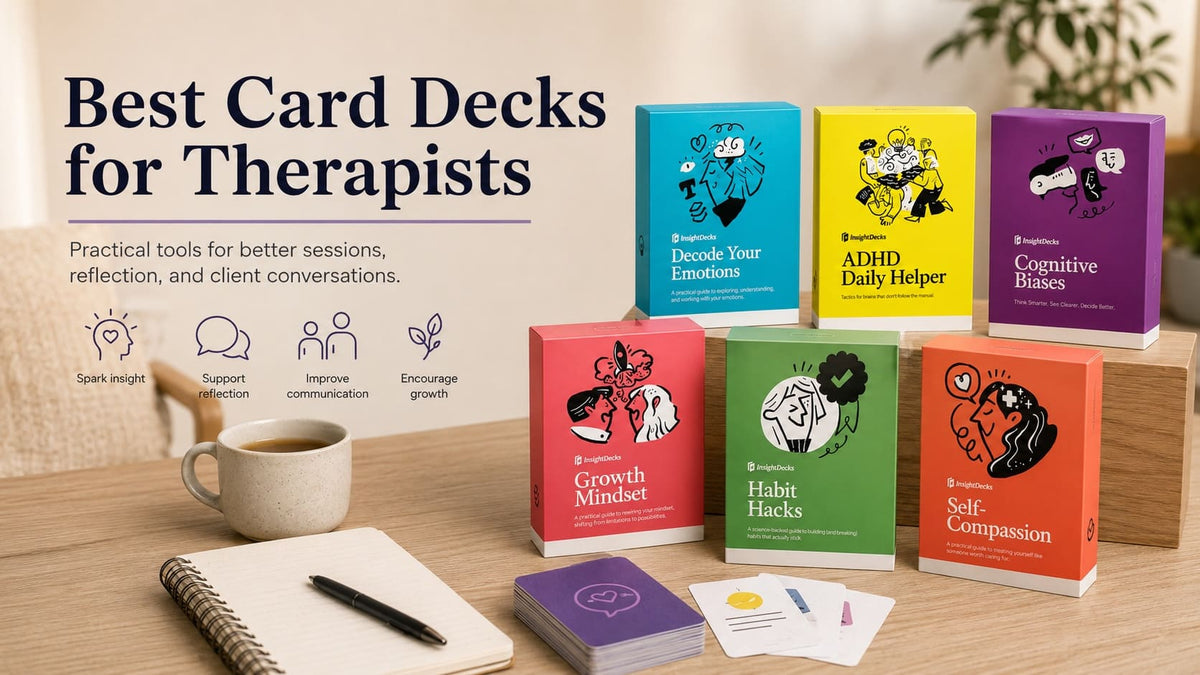
At Insight Decks, our decks are designed as practical tools for reflection, communication, emotional awareness, mindset, habits, and interpersonal growth. They are not replacements for clinical judgment or professional care, but they can be valuable aids for therapists, counselors, psychologists, social workers, coaches, and other helping professionals.
Below are some of the best Insight Decks for therapists and how they can be used in sessions.
1. Decode Your Emotions
Best for: emotional awareness, emotional vocabulary, self-reflection, journaling, therapy conversations
Decode Your Emotions is one of the strongest starting points for therapists who want to help clients better understand what they feel and why.
Many clients know they feel “bad,” “stressed,” “angry,” or “overwhelmed,” but they struggle to name the more specific emotional experience underneath. This deck helps create space for identifying and exploring emotions with more nuance.
Therapists can use Decode Your Emotions to help clients:
- Name emotions more accurately
- Explore what an emotion may be signaling
- Reflect on emotional triggers
- Build emotional vocabulary
- Connect feelings to needs, boundaries, or unresolved patterns
- Start journaling between sessions
How to use it in session:
Invite the client to choose a card that matches what they have been feeling recently. Then ask:
“What about this card feels familiar?”
“What situation brought this emotion up?”
“What might this emotion be trying to tell you?”
“What would a helpful response to this emotion look like?”
This deck is especially useful for clients who intellectualize, minimize their feelings, or struggle to describe emotional experiences clearly.
2. Self-Compassion
Best for: self-criticism, shame, perfectionism, inner dialogue, emotional healing
Self-Compassion is useful for clients who are harsh with themselves, constantly feel behind, struggle with shame, or treat themselves in ways they would never treat another person.
For many clients, growth does not come from more pressure. It comes from learning how to be honest with themselves without becoming cruel.
This deck helps therapists explore:
- Self-kindness
- Inner criticism
- Shame and guilt
- Emotional recovery
- Perfectionism
- Acceptance
- Supportive self-talk
- Resilience after mistakes
How to use it in session:
Use a card when a client describes a mistake, failure, conflict, or painful memory. Ask:
“How would you respond to a friend in this same situation?”
“What does your inner critic say here?”
“What would a more compassionate but still honest response sound like?”
“What part of you is asking for care right now?”
This deck is a strong fit for therapists working with clients who are high-achieving, self-critical, burned out, emotionally exhausted, or stuck in cycles of shame.
3. ADHD Daily Helper
Best for: ADHD support, emotional regulation, focus, routines, task initiation, self-advocacy
ADHD Daily Helper is designed for brains that do not always follow the standard productivity manual.
For therapists who work with ADHD clients, this deck can help turn broad struggles into practical conversations. Instead of staying stuck in “I can’t focus” or “I’m lazy,” the cards can support a more useful discussion around friction, environment, emotional regulation, time blindness, routines, and self-compassion.
Therapists can use ADHD Daily Helper to explore:
- Focus and attention
- Task initiation
- Time management
- Emotional regulation
- Rejection sensitivity
- Environmental design
- Routine building
- Advocacy and communication
- Shame around productivity struggles
How to use it in session:
Ask the client to choose one card that feels most relevant to their week. Then explore:
“Where did this show up recently?”
“What made this harder than it needed to be?”
“What would make this task easier to start?”
“What support, cue, or environment change would help?”
This deck is especially useful when clients need practical tools that feel realistic, not idealized productivity advice written by someone who has never lost their keys while holding them.
4. Cognitive Bias
Best for: thinking patterns, distorted assumptions, decision-making, self-awareness, reframing
Cognitive Bias helps clients notice the mental shortcuts and thinking traps that can shape their emotions, choices, and relationships.
While therapists should avoid turning sessions into lectures on psychology, cognitive bias cards can be excellent tools for helping clients recognize patterns in how they interpret situations.
This deck can support work around:
- Assumptions
- Overgeneralization
- Confirmation bias
- Catastrophizing
- Black-and-white thinking
- Emotional reasoning
- Defensive thinking
- Relationship misinterpretations
- Decision-making patterns
How to use it in session:
When a client describes a recurring interpretation, belief, or reaction, introduce a relevant card and ask:
“Could this thinking pattern be influencing how you see the situation?”
“What evidence supports this interpretation?”
“What evidence might complicate it?”
“What would be another way to read the same situation?”
This deck is useful for clients who overthink, spiral, jump to conclusions, or repeatedly misread situations through old protective patterns.
5. Growth Mindset
Best for: resilience, learning, motivation, confidence, reframing setbacks
Growth Mindset is a helpful deck for clients working through fear of failure, avoidance, low confidence, comparison, or discouragement.
It helps shift the focus from “What does this failure say about me?” to “What can I learn from this, and what is the next step?”
Therapists can use Growth Mindset to explore:
- Fear of failure
- Learning from mistakes
- Resilience
- Feedback
- Confidence
- Self-belief
- Effort
- Progress
- Identity and growth
How to use it in session:
Use this deck when a client is stuck in fixed thinking, such as:
“I’m just bad at this.”
“I always fail.”
“There’s no point trying.”
“I should already be better.”
Then ask:
“What would change if this were a learning moment instead of a judgment?”
“What skill is being developed here?”
“What is one small experiment you could try next?”
This deck is especially useful with teens, students, entrepreneurs, professionals, and clients working on confidence or personal development.
6. Habit Hacks
Best for: behavior change, routines, consistency, follow-through, realistic habit design
Habit Hacks is a practical deck for therapists who help clients build healthier routines, reduce avoidance, or create more supportive daily structures.
Many clients do not need another motivational speech. They need smaller steps, lower friction, better cues, and a plan that survives a normal messy week.
This deck can help with:
- Starting habits
- Reducing friction
- Building routines
- Recovering after missed days
- Environmental design
- Consistency
- Motivation
- Tiny behavior changes
- Breaking all-or-nothing patterns
How to use it in session:
Ask the client to identify one behavior they want to build or change. Then select a card and apply it directly:
“How could this tactic make the habit easier?”
“What is the smallest version of this habit?”
“What usually interrupts this routine?”
“What could we change in your environment?”
This deck works well for clients working on sleep routines, exercise, journaling, planning, emotional regulation practices, or follow-through.
7. Difficult Conversations
Best for: conflict avoidance, boundary-setting, feedback, relationship repair, preparation for hard talks
Difficult Conversations is a strong deck for therapists working with clients who need to prepare for hard conversations in their personal or professional lives.
Many clients know they need to say something, but they either avoid it, explode, over-explain, shut down, or rehearse it in their head for three weeks and still say nothing. Very human. Not always effective.
This deck can support work around:
- Boundary-setting
- Feedback
- Conflict preparation
- Repair conversations
- Emotional regulation before conversations
- Clarity of message
- Avoidance patterns
- Assertiveness
- Relationship tension
How to use it in session:
Use the deck when a client says, “I need to talk to someone, but I don’t know how.”
Ask:
“What is the real issue that needs to be named?”
“What outcome are you hoping for?”
“What do you need to say clearly?”
“What do you need to avoid doing in this conversation?”
This deck pairs especially well with Assertive Communication, Active Listening, and Conflict Resolution.
8. Active Listening
Best for: empathy, relationship skills, couples work, family communication, leadership, repair conversations
Active Listening helps clients improve how they listen, respond, and stay present in conversations.
This is valuable in individual therapy, couples work, family therapy, leadership coaching, and relationship-focused sessions.
The deck can support:
- Empathy
- Presence
- Curiosity
- Reflective listening
- Reducing defensiveness
- Validating without fixing
- Better responses during conflict
- Communication repair
How to use it in session:
Use a card during role-play or conversation rehearsal. Ask the client to practice listening for understanding before responding.
Questions might include:
“What did you hear the other person really saying?”
“What emotion might be underneath their words?”
“How could you reflect that back without agreeing or disagreeing yet?”
“What would help the other person feel heard?”
This deck is excellent for clients who interrupt, fix, defend, withdraw, or struggle to stay emotionally present in hard conversations.
9. Assertive Communication
Best for: boundaries, people-pleasing, confidence, direct communication, asking for needs
Assertive Communication helps clients express themselves clearly without becoming passive, aggressive, or apologetic.
It is especially useful for clients who struggle with people-pleasing, resentment, avoidance, guilt, or fear of disappointing others.
Therapists can use this deck to explore:
- Boundaries
- Needs
- Requests
- Saying no
- Feedback
- Self-expression
- Confidence
- Conflict avoidance
- Communication patterns
How to use it in session:
Use a card to help the client prepare language for a real-life situation.
Ask:
“What do you need to say?”
“What are you afraid will happen if you say it?”
“How can this be said clearly and respectfully?”
“What would be too passive? What would be too aggressive? What would be assertive?”
This deck works well with clients learning to advocate for themselves in relationships, work, family systems, or friendships.
10. Conflict Resolution
Best for: relational conflict, workplace tension, recurring disagreements, repair, perspective-taking
Conflict Resolution helps clients understand conflict more clearly and move toward constructive next steps.
It can be useful in individual therapy when a client is processing conflict, as well as in couples, family, or group settings where appropriate.
This deck supports:
- Conflict patterns
- Needs and interests
- Emotional triggers
- Perspective-taking
- De-escalation
- Repair
- Accountability
- Problem-solving
- Resolution planning
How to use it in session:
Ask the client to describe a conflict, then use a card to examine one part of the dynamic.
Questions might include:
“What keeps this conflict repeating?”
“What need is not being expressed clearly?”
“What part of the conflict belongs to you?”
“What would repair look like here?”
This deck is especially helpful when clients are stuck in blame and need a more constructive way to understand the disagreement.
Why therapists use card decks in sessions
Card decks are useful because they turn big, messy topics into small, manageable prompts.
Instead of asking a client, “How do you feel?” and watching them freeze, a therapist can use a card to give the conversation a starting point.
Therapy card decks can help with:
- Emotional awareness
- Self-reflection
- Cognitive reframing
- Communication skills
- Relationship patterns
- ADHD support
- Habit change
- Self-compassion
- Conflict exploration
- Session warm-ups or closing reflections
The real advantage is usability. Books are long and linear. Worksheets can feel clinical. A card deck is modular, tactile, and easy to adapt in the moment.
You can pull one card. Let the client choose one. Spread several cards on a table. Use a card as a journaling prompt. Build an entire session around one idea.
That flexibility makes decks especially useful in therapy.
Best Insight Decks by Therapy Use Case
For emotional awareness
Best decks:
- Decode Your Emotions
- Self-Compassion
- Cognitive Bias
Use these when clients need help naming emotions, understanding emotional patterns, or responding to themselves with more care.
For ADHD support
Best decks:
- ADHD Daily Helper
- Habit Hacks
- Self-Compassion
Use these when clients need practical strategies for focus, routines, emotional regulation, task initiation, and reducing shame.
For self-critical clients
Best decks:
- Self-Compassion
- Growth Mindset
- Cognitive Bias
Use these when clients are stuck in shame, perfectionism, harsh inner dialogue, or fear of failure.
For couples and relationship work
Best decks:
- Couples Card Deck
- Active Listening
- Difficult Conversations
- Assertive Communication
- Conflict Resolution
Use these to support communication, emotional honesty, repair, listening, boundaries, and deeper connection.
For clients preparing for hard conversations
Best decks:
- Difficult Conversations
- Assertive Communication
- Active Listening
- Conflict Resolution
Use these when clients need to say something important but feel anxious, avoidant, reactive, or unclear.
For behavior change
Best decks:
- Habit Hacks
- ADHD Daily Helper
- Growth Mindset
Use these when clients want to build routines, follow through, recover after setbacks, and make change feel more manageable.
For thinking patterns and reframing
Best decks:
- Cognitive Bias
- Growth Mindset
- Mental Models
Use these when clients need to examine assumptions, reframe setbacks, or make decisions with more clarity.
How therapists can use card decks in practice
1. As a session opener
Ask the client to choose a card that reflects how they are arriving today.
This can help clients transition into the session and give you a faster read on what feels alive for them.
2. As a session focus
Choose one card and build the session around it.
This works especially well when the client feels scattered or does not know where to begin.
3. As a reflection prompt
Use a card to deepen exploration.
For example, after a client shares a story, you might ask, “Which card feels connected to what you just described?”
4. As homework
Give the client one card to reflect on between sessions.
They can journal about it, notice where it shows up during the week, or practice one small action connected to the card.
5. As a conversation rehearsal tool
Use decks like Difficult Conversations, Assertive Communication, and Active Listening to help clients prepare for real conversations.
This can make the work more concrete and less theoretical.
6. As a visual sorting exercise
Spread several cards on a table and ask the client to sort them into categories:
- This feels familiar
- This feels hard
- This is what I want to practice
- This is what I avoid
- This is what I need more of
This kind of exercise can reveal patterns quickly.
Are Insight Decks therapy cards?
Insight Decks can be used by therapists, but they are not clinical treatment tools, diagnostic instruments, or substitutes for professional care.
They are educational, reflective, and practical card decks that can support therapeutic conversations when used appropriately by qualified professionals.
Therapists can adapt them based on the client’s needs, age, context, and therapeutic goals.
Are card decks better than worksheets?
Not always, but card decks often feel more inviting.
Worksheets can be useful, but some clients experience them as homework, schoolwork, or paperwork. Card decks can feel more approachable, flexible, and interactive.
The best format depends on the client. Some people love structure. Some resist anything that looks like a form. A deck gives you another option.
Are card decks better than books for therapy?
Books are excellent for depth. But therapy often needs tools that are easy to use in the moment.
A book is long-form and sequential. A card deck is modular and flexible.
That means a therapist can pull one card, select a few relevant cards, let the client choose, or use cards as prompts for conversation, reflection, role-play, or homework.
Books are built for reading. Decks are built for using.
Which Insight Deck should therapists start with?
For most therapists, the best starting decks are:
-
Decode Your Emotions
Best for emotional awareness and reflection. -
Self-Compassion
Best for self-criticism, shame, and inner dialogue. -
ADHD Daily Helper
Best for practical ADHD support. -
Difficult Conversations
Best for clients preparing for hard conversations. -
Active Listening
Best for relationship and communication work. -
Cognitive Bias
Best for thinking patterns and reframing.
The strongest starter set for many therapists would be:
Decode Your Emotions + Self-Compassion + ADHD Daily Helper + Difficult Conversations + Active Listening + Cognitive Bias
That gives you coverage across emotions, self-talk, neurodivergent support, communication, relationships, and thinking patterns.
Final thoughts
The best card decks for therapists are not gimmicks. They are tools that make important conversations easier to start, structure, and remember.
Insight Decks are designed to help people reflect, communicate, think, and act with more clarity. For therapists, they can bring a practical, tactile layer into sessions without turning the work into a lecture or worksheet marathon.
Whether you work with emotions, ADHD, self-criticism, relationships, communication, conflict, habits, or mindset, the right deck can give clients a simple doorway into deeper work.
And sometimes that is exactly what a session needs: not a perfect question, not a 300-page book, just one good card at the right moment.
Share: