


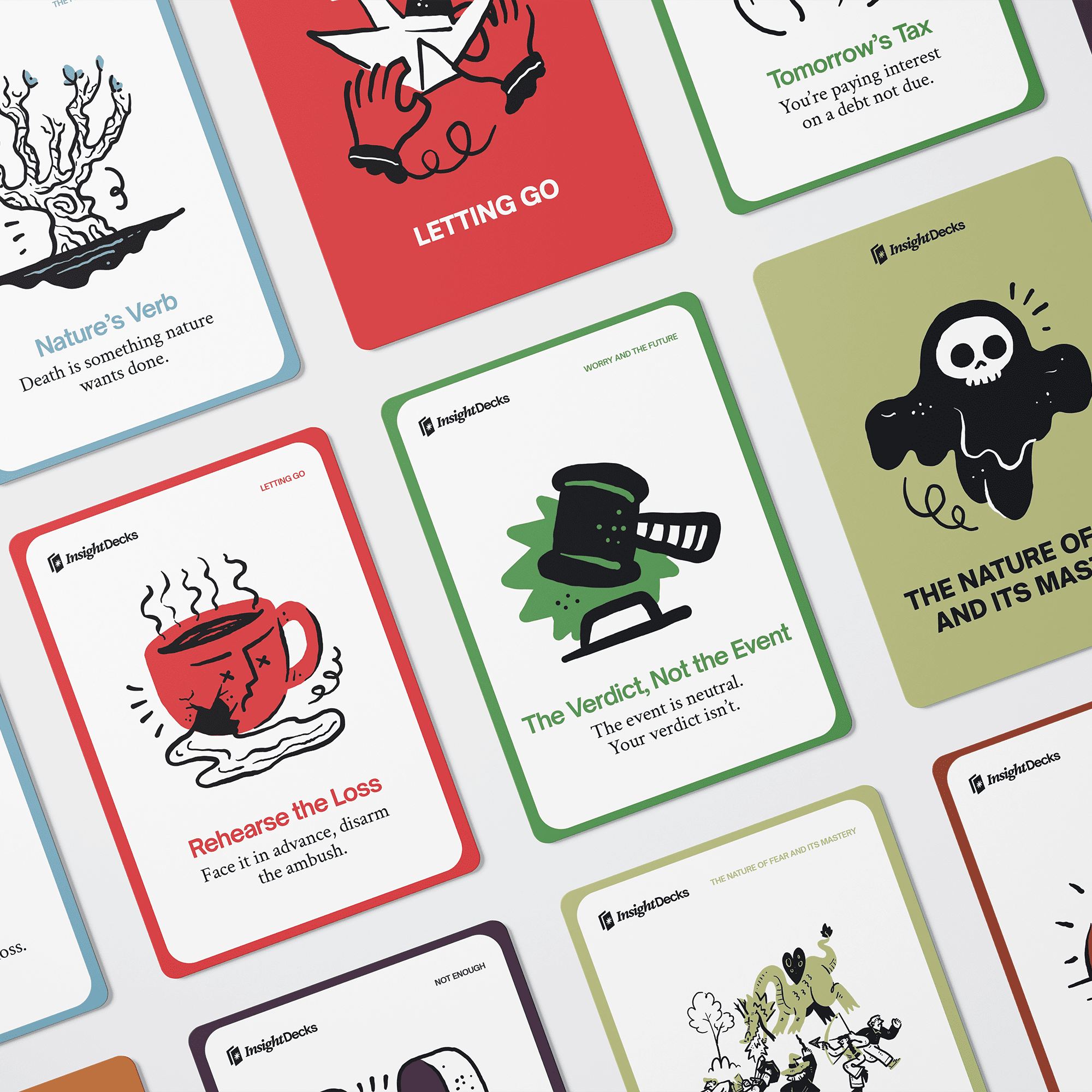


Fear Not
Eight wisdom traditions. Two thousand years. One instruction they all reached on their own.
✅ 50+ cards carrying the answer the Stoics, the Gita, the Qur'an and five more arrived at separately
✅ Eight themes: the unknown, death, loss, worry, judgment, crisis, not being enough, fear itself
✅ The front names the fear. The back puts you to work. One practice, three questions, one closing insight
What is the Fear Not Card Deck?
Everyone tells you not to be afraid. Nobody tells you how. A quote calms you for an hour. A breathing app closes when the meeting starts.
The Fear Not Card Deck is different: it hands you the practice, not the platitude. 50+ cards, eight traditions, one premise. Fear not was never a feeling to sit around waiting for. It was an instruction, and it comes with steps.
How does the Fear Not Card Deck help you?
Fear rarely shows up as fear. It shows up as prudence. As the email you'll send tomorrow. As eight months of still thinking it over.
Every card calls it by name: a teaching, one practice, three questions that find the thing you're gripping. No belief required. The traditions supply the answer. The questions are how you answer back.
How to use the Fear Not Card Deck?
Pick an entry point. No sequence to follow, nothing to complete.
- The Loud Moment. Fear is talking right now. Pull one card at random, do the practice, answer the three questions. Five minutes, and it is smaller for having been looked at.
- The Named Fear. You already know which one has you. Go to its theme, read the guide card, work the six or seven cards in that group. Good for a Sunday morning, better for the week before something hard.
- The Table. Lay a card between two people. A therapy hour, a men's group, an offsite, the conversation at home you keep postponing. The card asks, so nobody has to volunteer.
- The Long Walk. One card a day, in order, all fifty-one. About seven weeks to cross every fear the traditions bothered to name.
How you know it is working: you will catch yourself reaching past a card to get to an easier one. Go back and take the one you skipped. Fear does the sorting for you, it just does it backwards.
Fear Not
Trusted by



See how it looks like 👇
"I'm not really an anxious person" 🎭
Probably true. The people most governed by fear are rarely the ones shaking. They hit their deadlines, run their teams and give good advice.
You call it being realistic. You call eight months of dodging a decision "still gathering information." You stay in the job, the city, the relationship, and you build a beautiful vocabulary of good reasons for it. Fear that admits its name gets dealt with in a week. Fear that calls itself judgment gets a promotion.
The Fear Not Card Deck goes after the disguises. What are you protecting when you hesitate? What has your caution already cost, counted in years? Some cards will confirm what you suspected. One or two will feel like being caught. Draw those twice.
Preview some Fear Not Cards 👀


Read a hundred quotes about courage. Still stuck? 📚
Reading a teaching feels like doing something. You get the hit of insight, then Wednesday arrives and your behavior is identical. You have been consuming courage instead of practicing it.
So we closed the gap. Marcus Aurelius on death becomes: name what you dread as a natural process, the way you name the seasons. Epictetus on control becomes: two lists, sort ruthlessly, act on the first, release the second. Same wisdom. Now with instructions.
8 traditions that never met, and one answer they all found 🕯️
We did not set out to prove the traditions agree. We found out they already did, and that changes the weight of the claim. One tradition telling you to fear less is a doctrine. Rome, Jerusalem, Mecca, the Punjab and the Ganges arriving at it separately, with no contact and no shared assumptions, starts to look like evidence about how human beings are built.
Fifty-one teachings, sorted by the fear you brought with you:
✅ Stepping Into the Unknown and Worry and the Future for the fears that live ahead of you: the leap you keep postponing, the disaster you keep rehearsing, the tax you are paying on a debt that is not due.
✅ Letting Go, Not Enough and The Eyes of Others for the fears that live in your grip: what you might lose, what you might not be, and who might be watching when you fail.
✅ In the Storm, The Fear of Death and The Nature of Fear and Its Mastery for the deep water: crisis, mortality, and the question sitting underneath both, which is what fear is made of and whether it was ever the truest thing about you.
Who Is It For?
✅ The competent and quietly stuck: Your fear does not look like fear. It looks like not-yet.
✅ Therapists, coaches and facilitators: The card asks the hard question, so you do not have to.
✅ Readers who want the practice: You own the Meditations. Every card here ends in something to do.
✅ Anyone standing at an edge: A diagnosis, a divorce, a move. Written by people who were there.
The card you reach for at 3 a.m. 🌙
Fear does not schedule itself. It arrives on the drive home, in the hour before the call, in the quiet after everyone has gone to bed. That is exactly when a phone is the worst tool in the house and a card is the best one.
50+ cards. No screen, no battery, no algorithm deciding what you need. A teaching that has held up for two thousand years, one thing to do about it, and three questions waiting for an honest answer.
There is no right order. Fear does not use one either.
Insightdecks
Got a Few Questions?
Who is this product for?
Anyone whose decisions are quietly being edited by fear, which is close to everyone. It suits people facing a real transition, readers of Stoic and contemplative philosophy who want practice instead of more theory, and professionals who work with other people's fear for a living: therapists, coaches, chaplains, facilitators and educators. No religious belief is required. The traditions are presented as sources of insight, not as doctrine, and you can take any card as a working question rather than a claim.
What does the card deck include?
50+ cards. Fifty-one teaching cards, each carrying an original quote from one of eight traditions, an expansion that unpacks it in plain language, one practice under the heading Try This, three questions under Ask Yourself, and a closing insight. Eight theme cards introduce each group of fears and tell you when to reach for it. One card explains the three ways to use the deck. Sources include the Hebrew Bible, the New Testament, the Qur'an, the Bhagavad Gita, the Dhammapada, the Guru Granth Sahib, the Tao Te Ching, and the Stoics: Epictetus, Seneca and Marcus Aurelius.
What formats are available?
- Digital version: Instantly accessible and downloadable.
- Digital + Physical version: Includes the digital version and a beautifully designed physical card deck shipped to your address.
What is the return policy?
Due to the digital nature of the product, refunds are not available for the digital version. For the physical version, if your product arrives damaged, please contact us within 14 days for a replacement.