


Very helpful especially on days I’m lacking motivation.
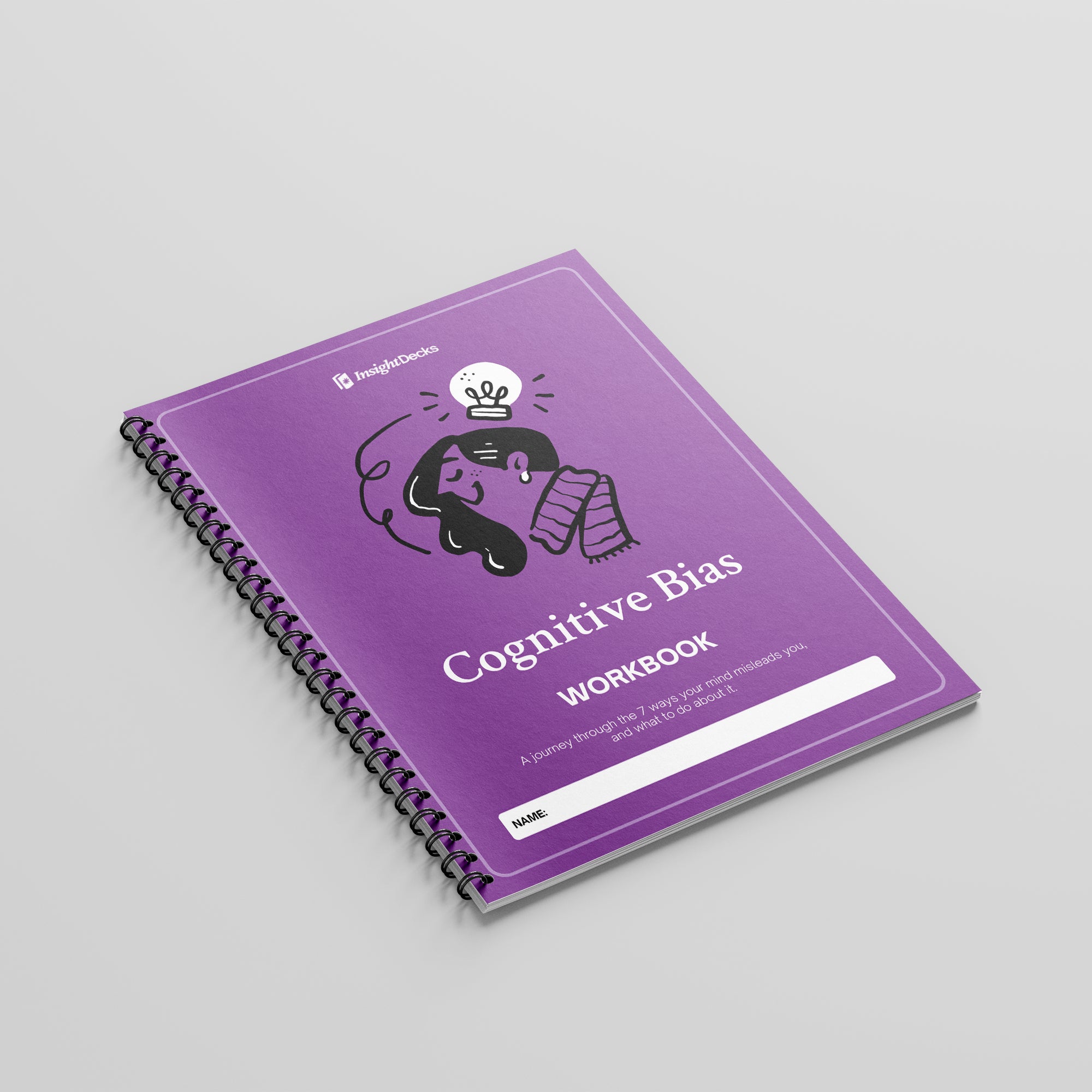
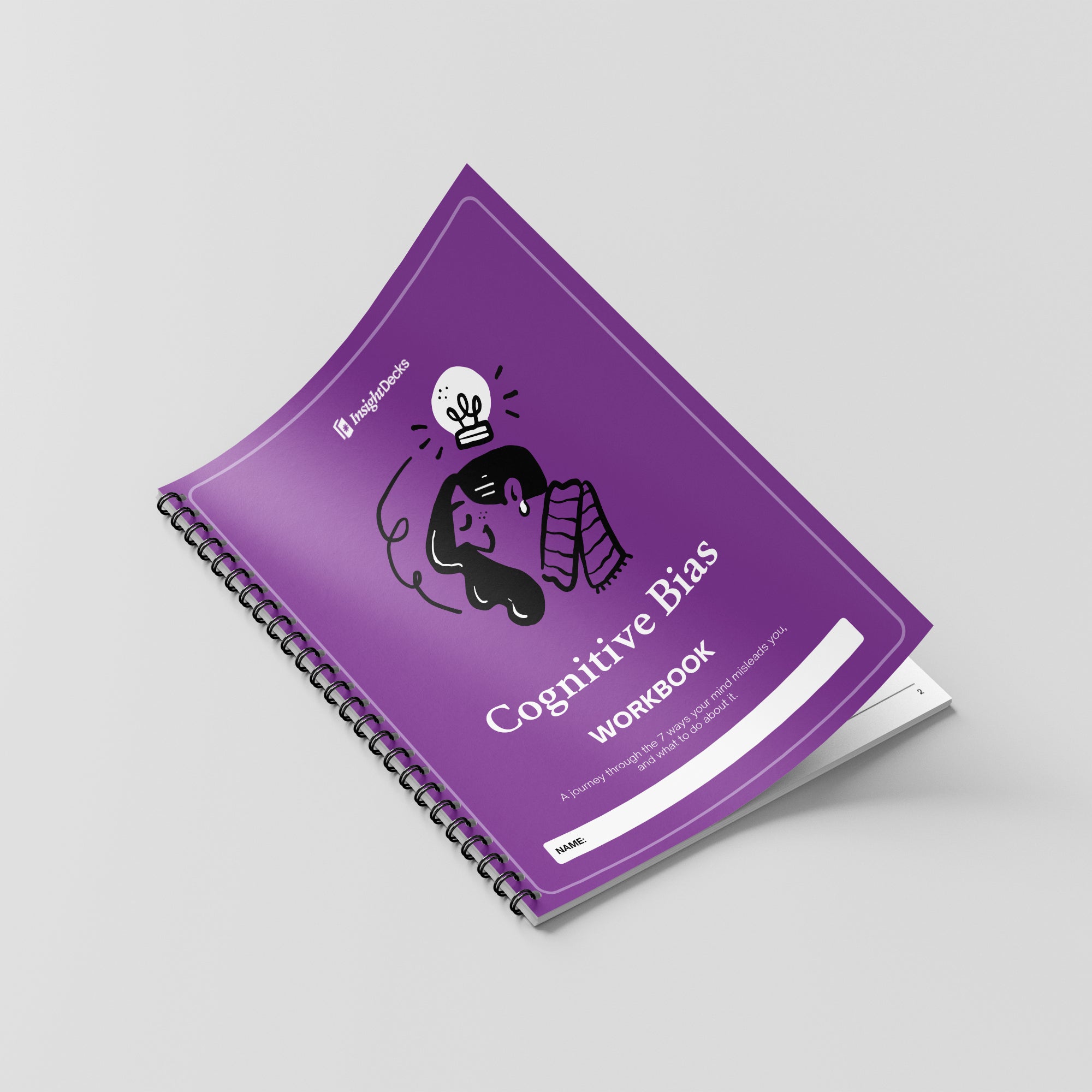
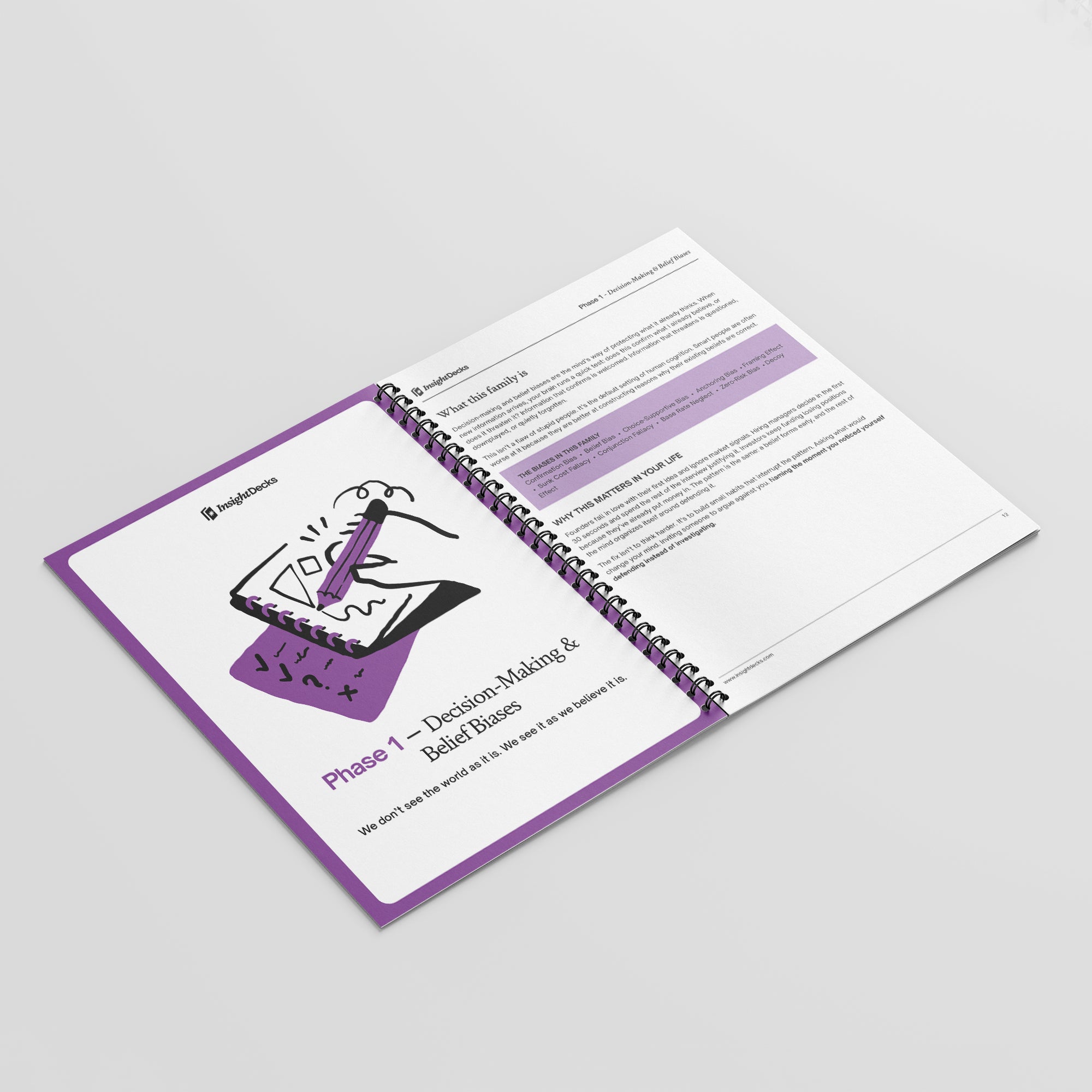
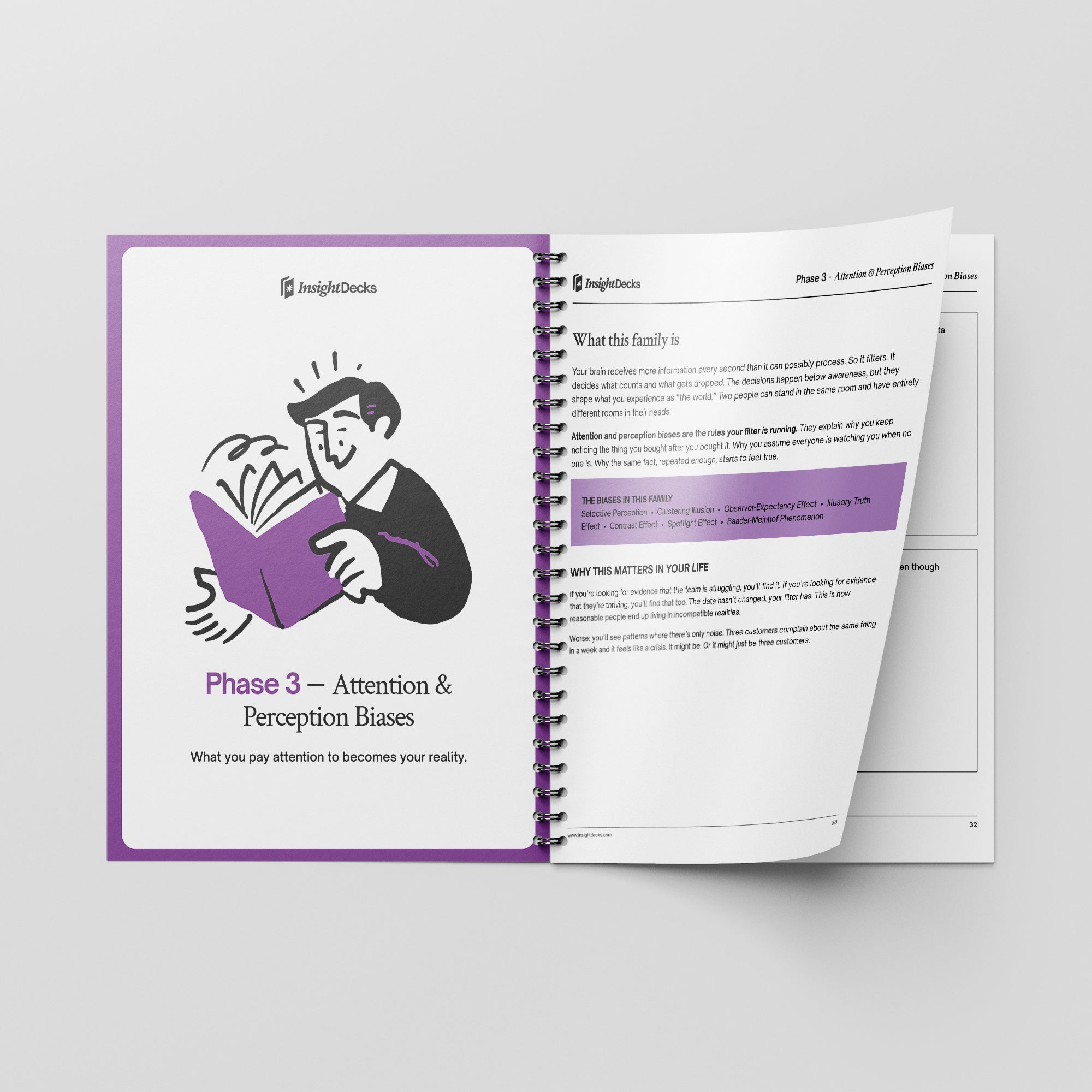
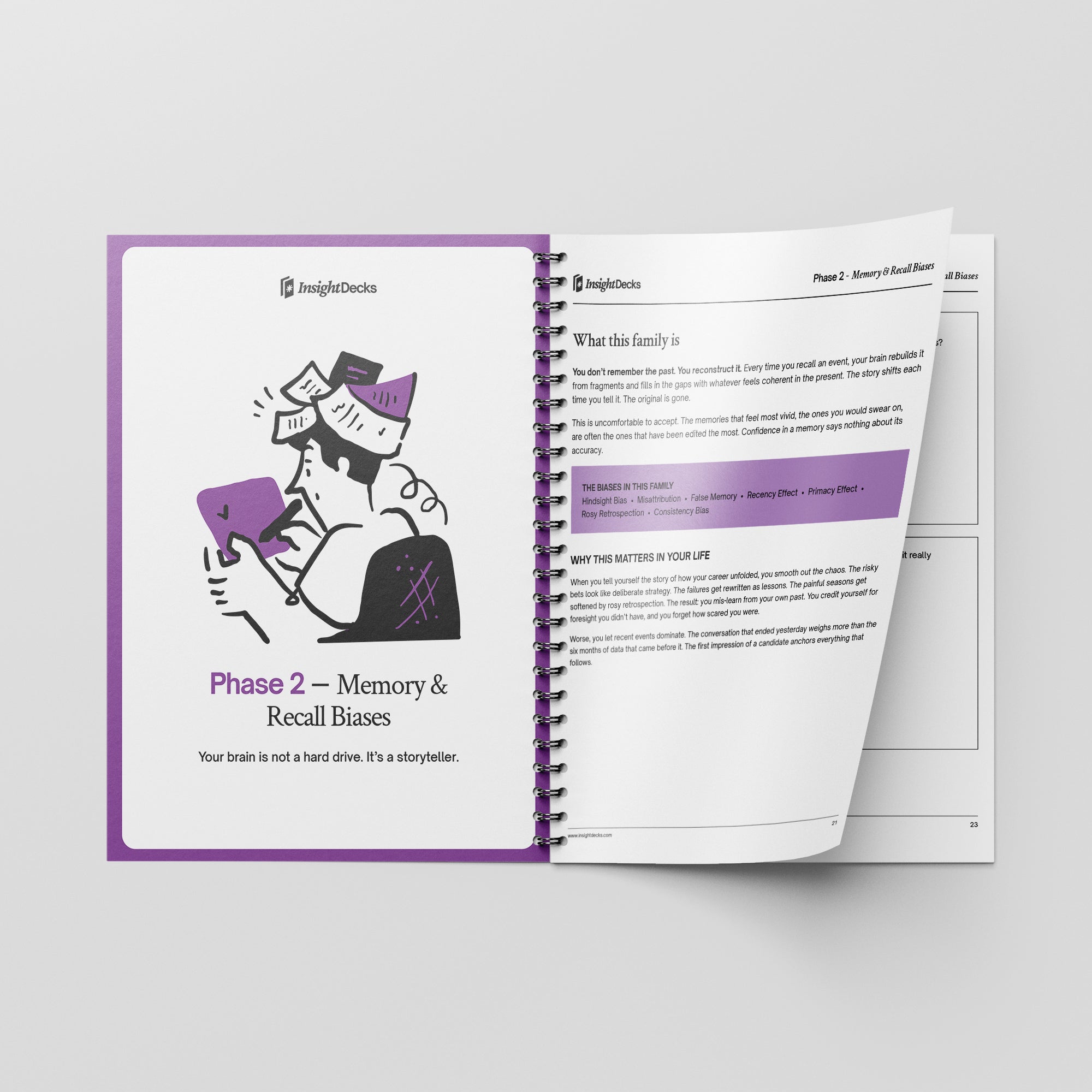
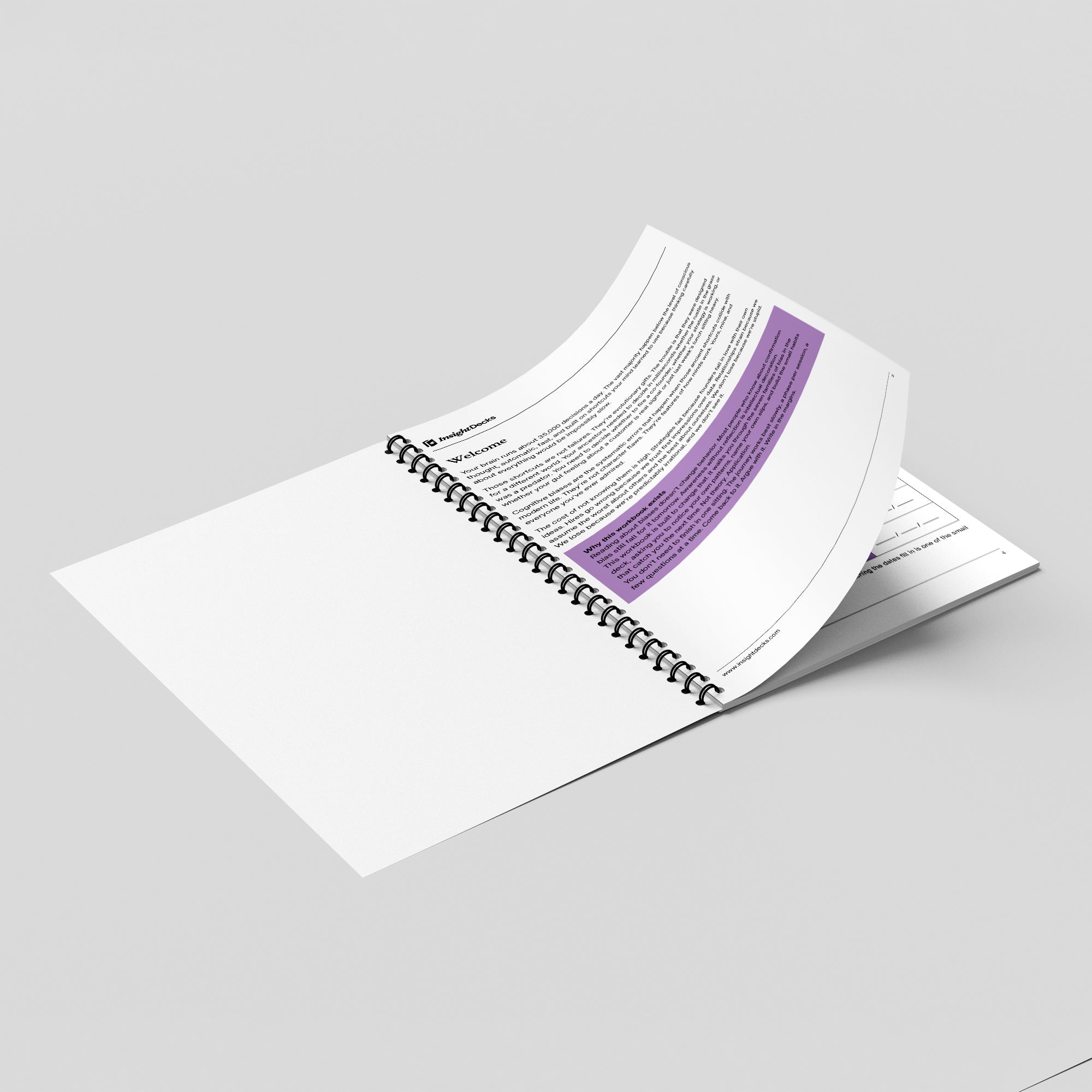
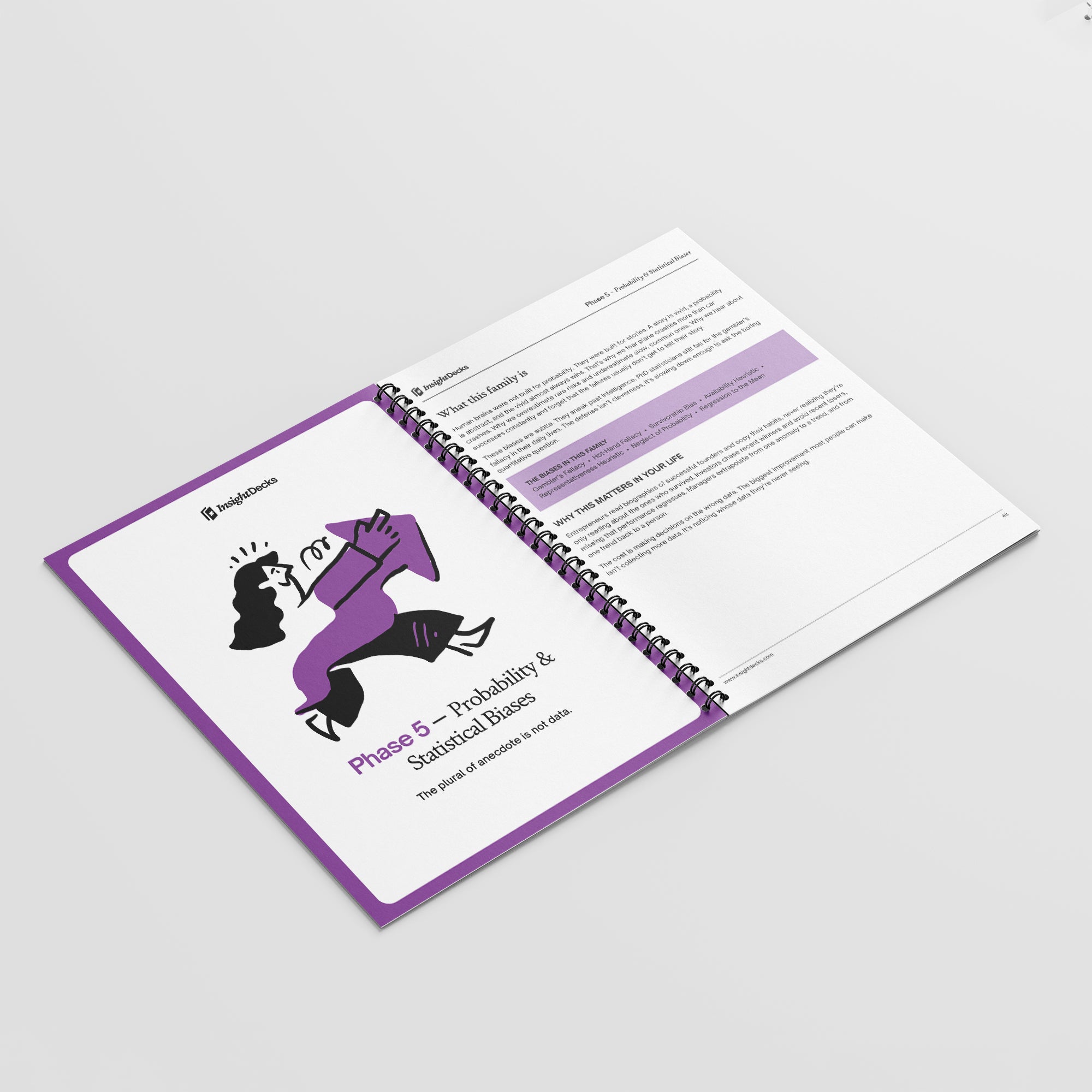
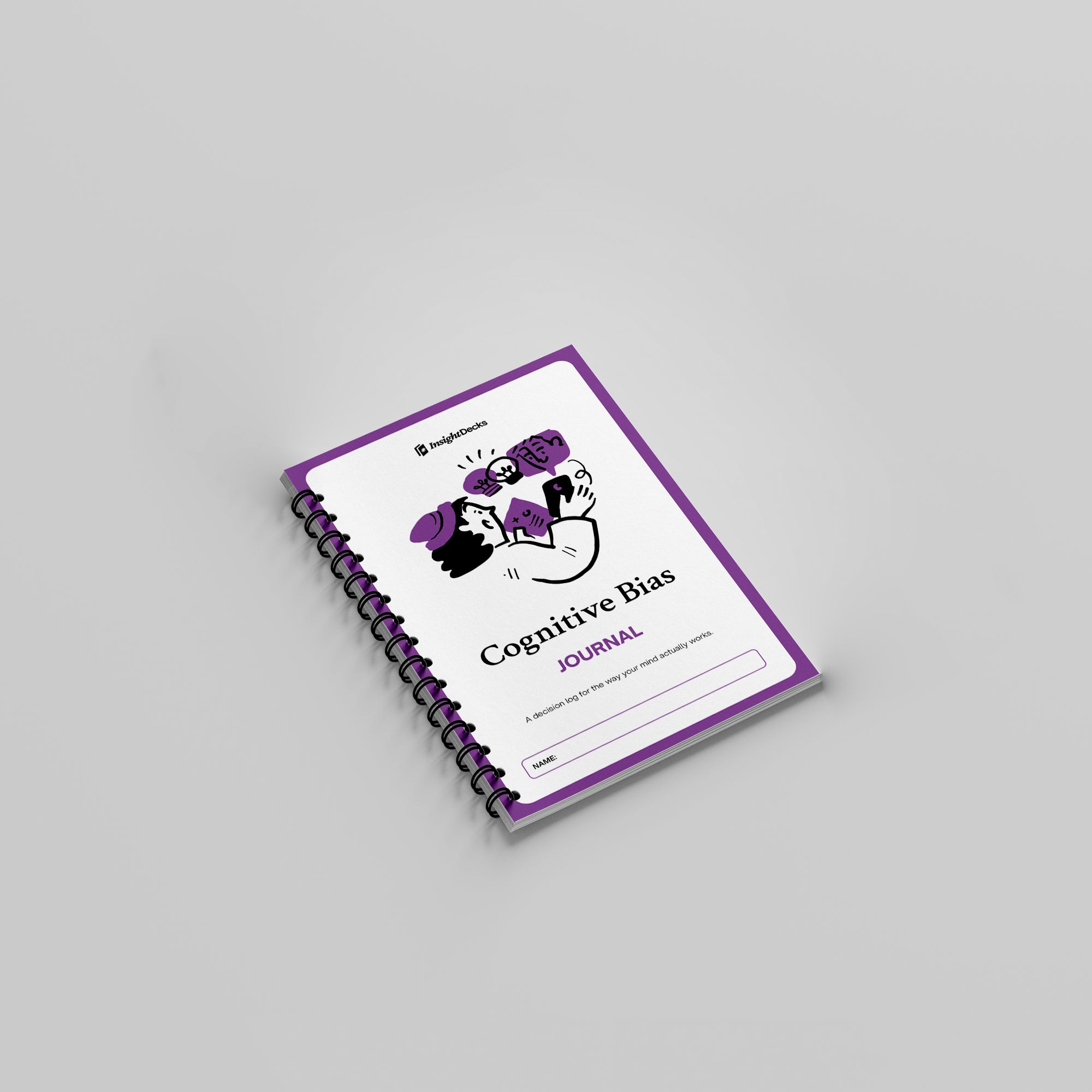
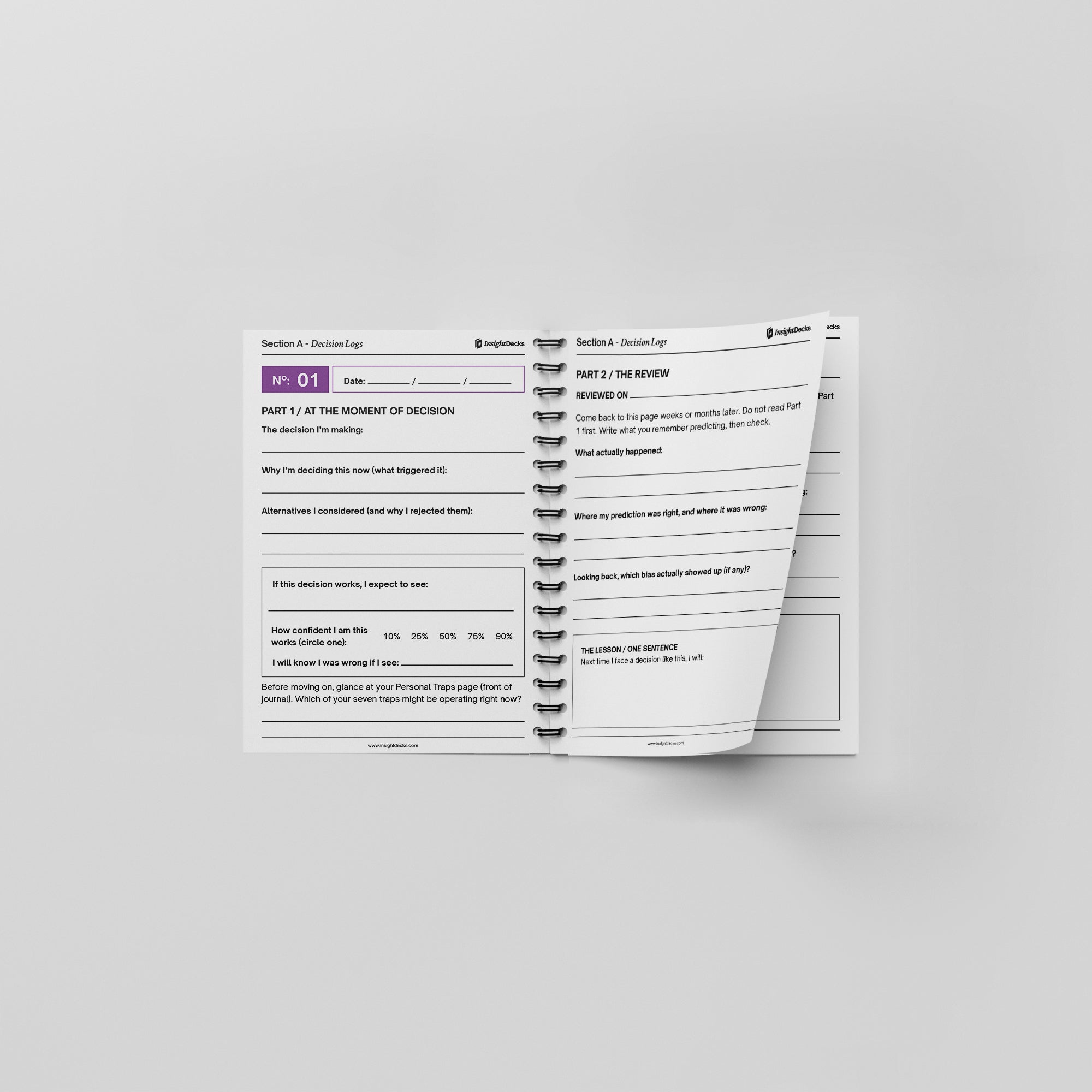
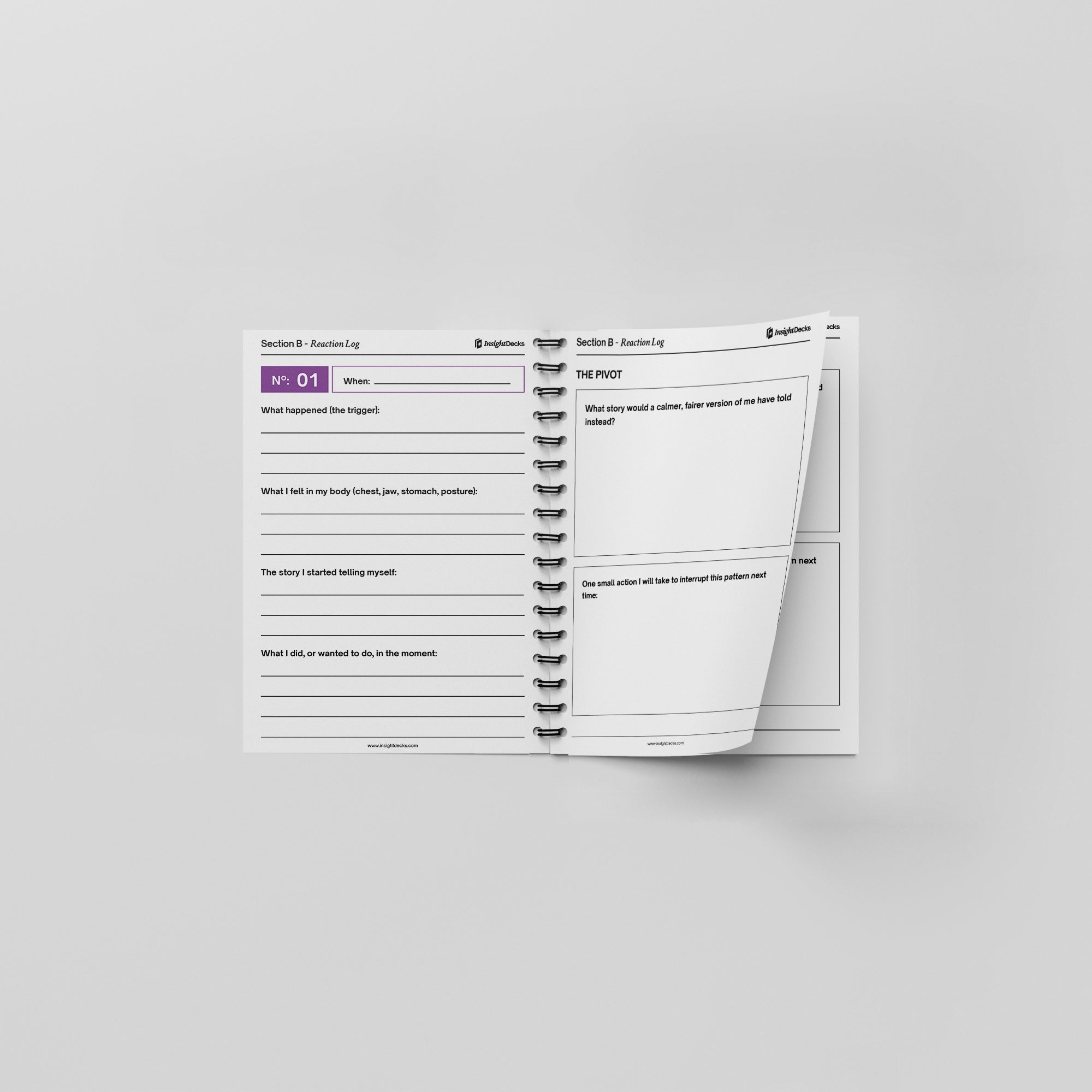
The Cognitive Bias Workbook & Journal is a two-part practice for thinking with your brain's blind spots instead of falling for them. The Workbook is for the deep dives: nine phases that take you from an honest baseline, through the seven families of bias, to your own personal shortlist of the traps you fall for most. The Journal is for real life: a decision log you run on yourself, where five minutes at the moment of choice turns into patterns you could never spot in the moment.
It pairs with the Cognitive Bias Card Deck. Where the deck hands you 50+ biases clearly defined, this Workbook & Journal helps you find the ones that actually run your decisions and build the small habits that catch them.
It comes as a Fillable PDF (Digital Version) you can complete on any device with PDF software. Type your answers right into the page, save, and pick up where you left off.
The Cognitive Bias Workbook & Journal is a two-part digital practice. A 9-phase workbook that maps the seven families of bias onto your own decisions. A decision-log journal to turn that insight into a habit you keep for months. Both are fillable PDFs.
Most advice on thinking tells you to be more rational. This one doesn't. It starts from your actual decisions, not theory, and gives you a mechanism to catch your biases in real time. The decision log creates the repetition that turns awareness into better calls.
Cognitive Bias Workbook & Journal






You make thousands of calls a year and remember only the ones that worked. The misses get quietly rewritten into "I always had doubts," and the lesson disappears with them.
That's the most expensive habit a smart person has: deciding with confidence, never auditing the result, mistaking a good story for a good track record.
The Cognitive Bias Workbook & Journal is the audit. It shows you how your mind makes its calls, where it fools you, and what to do the next time it tries.
You can already define confirmation bias. You'll still fall for it tomorrow. Awareness without a mechanism is just decoration, which is why reading another article changes nothing.
What changes behavior is friction in the right place. The Workbook walks you through the seven families until you can name your own patterns out loud. The Journal locks in your reasoning at the moment of choice, so hindsight can't quietly edit it later.
The Workbook: nine phases, one honest map
Score how you think today, work through all seven families with diagnostics and real-life reflections, then name the seven traps that are actually yours.
The Journal: a decision log, not a diary
Log a call as you make it, then review it weeks later and measure the gap between what you predicted and what happened. The same method used at Bridgewater and by Annie Duke, because it kills your mind's favorite trick: editing the past.
A companion to the Cognitive Bias Card Deck
Every phase connects back to the deck's 50+ biases, so spotting a trap always comes with the next move to handle it.
✅ You write down what would change your mind before you commit, instead of explaining it away after you've lost
✅ You see the gap between what you predicted and what actually happened, on paper, where it can't hide
✅ You stop reading "this person is difficult" off behavior you'd happily excuse in yourself
✅ You walk away with a personal shortlist of the biases that run you, and three small systems built to catch them
✅ Founders & Operators: When your calls scale, so do your blind spots.
✅ Marketing & Strategy Pros: For decisions made with messy data and a loud gut.
✅ Coaches & Therapists: A reflective tool for clients between sessions.
✅ The Dangerously Well-Read: You know every bias and still fall for all of them. This is where knowing becomes catching.
Overall rating: 4.6 / 5 from 135 reviews.
Very helpful especially on days I’m lacking motivation.

I ordered a bundle of these amazing cards and our whole family loves them! We use the emotions cards every evening at dinner with our kids. One person picks one and the others have to guess before the individual sections are read out. Lots of fun and very insightful! Thank you for creating these!

Got this to help with my own growth. Love how it's bite sized info in a card.

Great addition to coaching sessions and workshops!

Good Deck, Very usefull for everyday work !

Thank you for the card. My boss shared his selected card with the other leaders and provided a brief insight. Everyone is now sharing their reflections.

Delivery a bit slow but the cards are great. They response fast (though you should query within work hours). I like to use them for my own personal development :). Would definitely buy other decks.

I purchased the digital deck alone and put it to enough use that I returned for the physical deck. The brainstorm deck arrived along with an ice storm. I was delighted that when the power went out in my area my project was able to kick into high gear. With the brainstorm deck, a chart marker, easel pad, battery operated visual timer, whiskey and candlelight everything came together pleasantly.

PPC y marketing de contenido son 2 estrategias diferentes y puedes combinarlas, pero debes tener claridad de sus diferencias, eso lo pude saber gracias a esta super herramienta!!!

Es una herramienta que me ayuda a entender el propósito en la atención al cliente!! Super!

Excellent tools! Easy to apply with step by step guidance
Marketing Strategies Card Deck

Great deck. Read tens of books on growth mindset, but this deck was lot better and very very insightful.

I recently started using the InsightDecks Pricing Model deck, and it's become an invaluable resource in my professional work. Whether you're in marketing, sales, product management, or business strategy, this deck offers practical insights that directly apply to real-world challenges.

I've been using the InsightDecks Cognitive Bias card deck for a while now, and I can honestly say it's become one of my most valuable resources. What impressed me most is how practical and immediately applicable it is—this isn't just theoretical information gathering dust on a shelf.

I am new to marketing. Thanks to insightdecks, I can grasp to marketing concepts on-the-go, wherever. One thing I enjoy about the decks is, it provides clear action plans for every concept.
Marketing Strategies Card Deck

Adding my fourth edition to my insightdecks collection. I like it handy and I enjoy learning strategies and techniques in a casual, yet mind stimulating way. It is easy for me to apply to my work and daily life.

Just getting started, but they are what I expected. The pricing seems really high on these.
Assertive Communication Card Deck

Great deck. Very useful for me, who is AuDHD. The cards are made of great paper, not too thick but not too thin, either. I think I will buy more decks in the future.

The cards are better than I expected. Very useful in therapy work! Johanna
Decode Your Emotions Card Deck

I love seeing my decks every morning, just to remind myself the state of my emotions, as well as what I am wanting to achieve (emotionally). The decks help me to process my emotions and able to channel it to a healthier means. I would love to buy more decks on marketing, and other professional development.
Decode Your Emotions Card Deck

The experience cannot be shared in a day or a night. This is a treasure that requires quiet contemplation. With an ideal partner who shares my passion.
Business Strategy Decks Bundle

Got the bundle + emotions deck for my team. Seems really nice, very well designed and intuitive. Very sick, thanks.

Well packaged. Nice to have it, cannot wait to open and try it!
Marketing Strategies Card Deck

I love the cards format for explaining the different concepts and it’s also a great tool to use with my clients and my business. The exercises are also very helpful and easy to apply.

I have to say, the design of the cards are beautiful. Clean, modern, and super easy to read.

I run a small hair salon and always thought charging per service was the only way. After using the deck in a few brainstorming sessions with my team, we came up with a package model and a referral program we’d never considered before. It’s not magic, and it won’t do the work for you…but it definitely helps you think differently.

I’ve been using the Pricing deck in my consulting sessions. it’s been super helpful to explain different pricing models to clients. Clear, practical, and effective.

Beautifully made and incredibly practical. Excited to keep using it with new projects!!
Excellent quality and content. It's so handy in a card format. Can travel with the one you're studying and leave the remaining cards home.
Very nice!
I look forward to pulling a new card each day and focusing on it! Great idea! So helpful!
Highly recommend! One of the best tools for self reflection I've come across!
The workbooks curate lessons into a clear, reflective pathway. These resources get to the point without sacrificing detail. I cannot wait to dive in deeper...
Fabulous deck! Thank you!
Everything was fine.
Good Deck, very usefull for your company !
Good Deck, very usefull to recalibrate your way of thinking !
Good Deck, very usefull for your stategies !
Good Deck, very usefull for your stategies !
Good Deck, very usefull for your stategies !
You could read every book on decision-making and still make the same mistake on Monday. Awareness is not immunity. What actually shifts the odds is a system: somewhere to write the decision down, a reason to come back to it, and a habit that fires before the next big call.
The Workbook draws the map. The Journal keeps you honest. Run them together and, a year from now, you'll have something almost nobody has: evidence, in your own words, of how your mind really works.
Insightdecks
Anyone whose decisions carry weight and who'd rather make fewer predictable mistakes: founders and operators, professionals in marketing, product, and strategy, coaches and therapists who want a reflective tool for clients, and the well-read skeptic who knows the theory cold and still gets caught.
Nine sections: a Phase 0 baseline self-assessment, then one phase for each of the seven families from the deck: Decision-Making & Belief, Memory & Recall, Attention & Perception, Social & Attribution, Probability & Statistical, Emotional & Motivational, and Cognitive Shortcuts (Heuristics). It closes with a Synthesis phase where you re-score yourself and name your personal seven. Each phase mixes short framings, open reflections, scenario diagnostics, bias matrices, fill-in-the-blanks, and keyword walls. Plan roughly an hour per phase if you write fully.
Four sections. Decision Logs (40 pages) where you predict before you know and review weeks later. Reaction Logs (20 pages) to catch a bias in motion the moment you feel yourself defending, dismissing, or escalating. Monthly Reviews (12 pages) to read back and name the patterns. And a closing Year in Patterns. It opens with a Personal Traps page you fill once and return to often, the same decision-journal approach trusted at Bridgewater and the CIA.
Both the Workbook and the Journal come as a Fillable PDF that works on any device with PDF software. Type your answers straight into the page, save, and come back whenever you want. Prefer pen and paper? You can still print any page at home, but the file is built to be filled in digitally.
Due to the digital nature of the workbook, refunds are not available. If you encounter issues accessing your file, reach out and we’ll ensure you get what you paid for.